•  
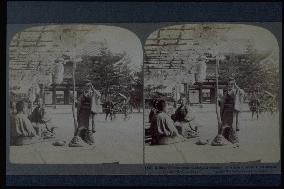
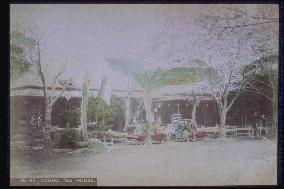
A teahouse in the precincts with a wisteria trellis

A teahouse in the precincts with a wisteria trellis

This is a teahouse in front of Otenmon Gate at Heian Shrine. Lanterns hang near the wisteria trellis. People are relaxing under the wisteria blossoms. A woman holding a parasol on a rickshaw is visible on the right, as well as Daigokuden Hall beyond the gate. The shrine was built in 1895. This may have been taken by the British photographer H. G. Ponting.==Date:unknown, Place:Kyoto, Photo:unknown, (Credit:Nagasaki University Library/Kyodo News Images) [Cabinet Number97‐43‐0]

  •  
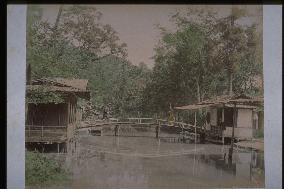
A teahouse,Shimogamo,Kyoto

A teahouse,Shimogamo,Kyoto

View of the Mitarashi River at Shimogamo Shinto Shrine. A woman riding a rickshaw and a woman with a parasol are passing each other on a bridge. There are summer pavilions on both sides of the river. The source of Mitarashi River is a spring at Mitarashi Shrine within the Shimogamo Shinto Shrine precincts. In the Meiji Period, bonfires were lit along the river and summer pavilions were built from which to observe them. In the back is Tadashi Forest.==Date:unknown, Place:Kyoto, Photo:unknown, (Credit:Nagasaki University Library/Kyodo News Images) [Cabinet Number85‐26‐0]

  •  
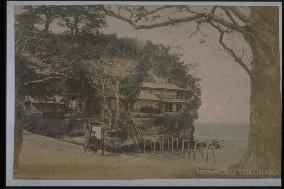
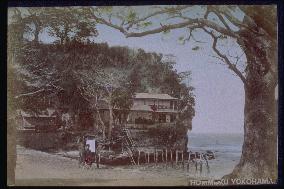
A teahouse at Honmoku Juniten

A teahouse at Honmoku Juniten

A road to Honmoku and Negishi was built for foreigners in 1864. Horse carriages were able to pass the following year, and many visitors came along the foot of the hill to enjoy the scenic beauty of Honmoku Juniten Shinto Shrine. Teahouses were built along the road, and people enjoyed bathing and gathering shellfish.==Date:unknown, Place:Yokohama, Photo:unknown, (Credit:Nagasaki University Library/Kyodo News Images) [Cabinet Number55‐5‐0]

  •  
Insho-tei,Ueno Park

Insho-tei,Ueno Park

The roof visible behind and above Insho-tei teahouse is the time bell at Kaneiji Temple. This bell is alluded to in Matsuo Basho's haiku Clouds of flowers, From where tolls the bell, Ueno or Asakusa? There were nine bell locations within the city of Edo, and these were used to mark the time every two hours. The bells served the role of clocks in medieval times. Even now they are rung at 6 a.m., noon, and 6 p.m.==Date:unknown, Place:Tokyo, Photo:unknown, (Credit:Nagasaki University Library/Kyodo News Images) [Cabinet Number53‐37‐0]

  •  
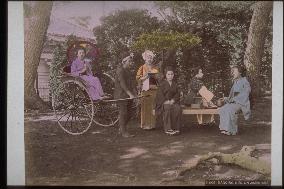
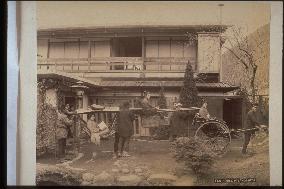
A maiko on jinrikisha and women relaxing at a teahouse

A maiko on jinrikisha and women relaxing at a teahouse

A kimono-clad woman is riding a jinrikisha (rickshaw). The short-haired rickshaw man holding the bar is wearing a head towel, sacerdotal robe, long underwear and heavy cloth socks. Three women are relaxing on a bench nearby, while another is standing. The latter is wearing an anesan kaburi head cloth. A large residence is visible behind a cluster of trees.==Date:unknown, Place:unknown, Photo:unknown, (Credit:Nagasaki University Library/Kyodo News Images) [Cabinet Number51‐168‐0]

  •  
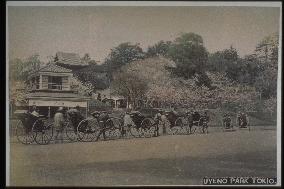
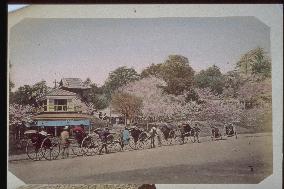
Insho-tei,Ueno Park

Insho-tei,Ueno Park

A caravan of rickshaws carrying people to view the cherry blossoms at Ueno Park. This photograph was taken some time after photograph #3155. The Seiyoken Annex sign is gone, and the cherry trees have grown. Shades are hanging from the eaves of the teahouse on the left, and its name, Insho-tei is written thereon. On the right, the Great Buddha still has its halo. Probably taken around 1895.==Date:unknown, Place:Tokyo, Photo:unknown, (Credit:Nagasaki University Library/Kyodo News Images) [Cabinet Number51‐47‐0]

  •  
A teahouse at Honmoku Juniten

A teahouse at Honmoku Juniten

A road to Honmoku and Negishi was built for foreigners in 1864. Horse carriages were able to pass the following year, and many visitors came along the foot of the hill to enjoy the scenic beauty of Honmoku Juniten Shinto Shrine. Teahouses were built along the road, and people enjoyed bathing and gathering shellfish.==Date:unknown, Place:Yokohama, Photo:Tamamura Kozaburo, (Credit:Nagasaki University Library/Kyodo News Images) [Cabinet Number48‐88‐0]

  •  
Teahouses at Ueno Park

Teahouses at Ueno Park

This is the same location as that in #4198. The man on the right has his hand on a bicycle, a fad at the time. The front wheel of the bicycle is large and the back wheel small. This was called the Ordinary Bicycle. The size of the wheels indicates that it is the type developed by Bayliss Thomas 1879.==Date:unknown, Place:Tokyo, Photo:Tamamura Kozaburo, (Credit:Nagasaki University Library/Kyodo News Images) [Cabinet Number48‐61‐0]

  •  
Teahouse at Nezame-no-toko Pass

Teahouse at Nezame-no-toko Pass

Probably the Fukushima juku with a sekisho on the Nakasendo, presently the Fukushimacho of Kisogun of Nagano prefecture. The annex of the Kiso family was built earlier than the other lodging villages in Kiso. The woman on the rickshaw in the center and a person with a balancing pole is seen in the bottom right.==Date:unknown, Place:Nagano, Photo:Kusakabe Kinbei, (Credit:Nagasaki University Library/Kyodo News Images) [Cabinet Number38‐10‐0]

  •  
Teahouse at nikko umagaeshi

Teahouse at nikko umagaeshi

Umagaeshi is the starting point of Chuzenjido, leading to a rugged path in the mountains to Ohira. The picture shows a teahouse and a palanquin. The teahouse is probably Tsutaya.==Date:unknown, Place:Nikko, Photo:unknown, (Credit:Nagasaki University Library/Kyodo News Images) [Cabinet Number26‐2‐0]

  •  
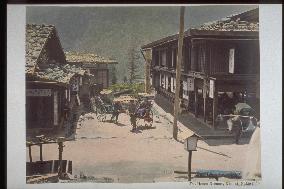
Miyanoshita hot spring teahouse

Miyanoshita hot spring teahouse

In front of the Miyanoshita Teahouse, the vehicles used at the time in Hakone line up; from left: rickshaw, chair and sedan. This teahouse built in 1885 was used for the pleasure of foreigners staying at the Fujiya Hotel, and it still exists as a village house.==Date:unknown, Place:Hakone, Photo:unknown, (Credit:Nagasaki University Library/Kyodo News Images) [Cabinet Number24‐11‐0]

  •  
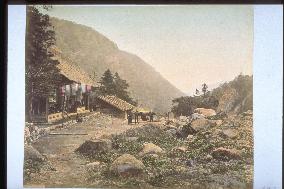
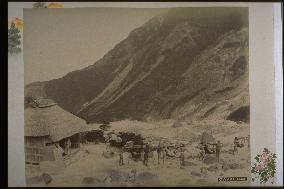
Palanquins at owakudani valley

Palanquins at owakudani valley

A tea house and procession of passengers in palanguins. Owakudani was toured on foot, or in palanguins or chairs (for foreigners). From the title on the negative, we can see that this photo was taken by Shima Shukichi who owned a photo studio in Miyanoshita. The mountain on the opposite side is Kanmuridake.==Date:unknown, Place:Hakone, Photo:Ogawa Kazumasa, (Credit:Nagasaki University Library/Kyodo News Images) [Cabinet Number5‐14‐0]

  •  
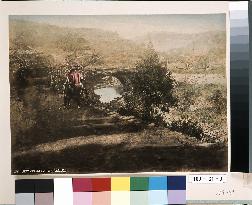
Hotarujaya and Ichinose-bashi Bridge

Hotarujaya and Ichinose-bashi Bridge

Hotarujaya is viewed from the upstream side. Ichinose Bridge is on the right of the teahouse, and the handrail is visible through the trees. The road on the left is Nagasaki Road leading to Himi Pass. A new road stretching from this point to Yagami on the other side of the mountain was constructed in 1882 by the Himi Shindo Co. led by Matsuda Gengoro and eight others. This was Japan's first toll road, charging one sen a person.==Date:unknown, Place:Nagasaki, Photo:unknown, (Credit:Nagasaki University Library/Kyodo News Images) [Cabinet Number109‐31‐0]

  • Main
  • Top
  • Editorial
  • Creative
  • About Us
  • About ILG
  • Terms of use
  • Company
  • BEHIND
  • Price List
  • Single Plan
  • Monthly Plan
  • Services
  • Shooting
  • Rights Clearance
  • Support
  • FAQ
  • How To Buy
  • Contact Us
  • Become a Partner

© KYODO NEWS IMAGES INC

All Rights Reserved.

  • Editorial
  • Olympics
  • News
  • Sports
  • Japan
  • Tech
  • Royal
  • Disaster
  • NorthKorea
  • Old Japan
  • SNS
  • Creative
  • Food
  • Japan
  • Landscape
  • Animal
  • Popular
  • #Ukraine
  • #China
  • #coronavirus
  • #N. Korea
  • #Thailand
  • #Russia
  • #Ukraine
  • #China
  • #coronavirus
  • #N. Korea
  • #Thailand
  • #Russia
  • Food
  • Japan
  • Landscape
  • Animal
  • Olympics
  • News
  • Sports
  • Japan
  • Tech
  • Royal
  • Disaster
  • NorthKorea
  • Old Japan
  • SNS